
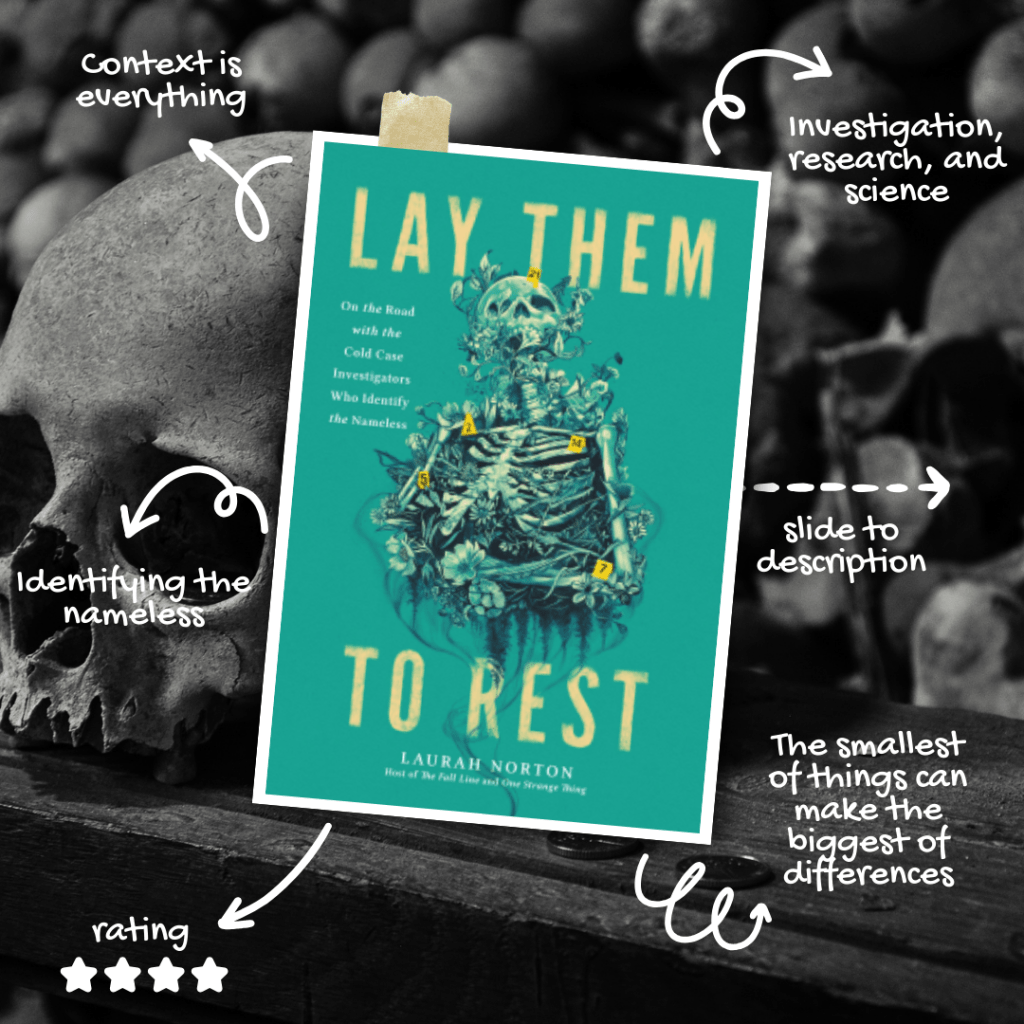

Lay Them to Rest was a fascinating, in-depth look at how investigators, researchers, doctors, and scientists use various methods of discovery to identify unknown remains. Jane and John Does that have met their end without a name. Laurah Norton and her associates take on some of these cases, seeking to name the nameless. But the road to identification is anything but easy in many cases.
This book takes the case of Ina Jane Doe as the backbone for learning about the technology and the hands-on research and investigation needed to identify unknown remains. It delves into the changes and progressions that have been made across many fields, but also highlights how the final identification requires so much more than a DNA sample or dental record. A lot of identification is in the context clues, and those can be hard to sift out of what is left behind. It also notes that databases are only as good as the information they contain and that so much of the process is finding the right information at the right time and in the right context. Which is not always possible.
This is the real-life version of the TV show Bones, and it shows just how long things can take, and how much one has to be cognizant of bias and ethics and the realities of the science to be able to piece together an identity from remains that can’t talk (at least not in a way most of us can understand). Using the process of identifying a single set of remains, and tying in other cases was a great way to bring along the reader into the entire process, from start to finish, of what is needed to happen to put a name to a reconstructed face. And that even once you have a name, there can still be a lot of unanswered questions.
*Thank you to NetGalley and the publisher, Hachette, for the eARC of this book. All opinions are my own.
 scijessreads
Leave a comment